The short answer
Attach the breakaway cable of a trailer with a breakaway braking device to the designated eye on the car or towbar. Alternatively, use an attachment arrangement that the manufacturer permits for your combination. A loose loop placed only over the towball is not a suitable attachment in the Netherlands.
How the hook is used depends on the cable. A spring hook is often passed through the attachment point and clipped back onto the cable. Clipping directly into an eye is only permitted if the cable, hook and attachment point are suitable according to their instructions. Keep the cable clear of the jockey wheel. It must not drag on the road or apply the brake in a bend. This article covers use in the Netherlands.
Source: AL-KO manual (Dutch pp. 13–16)
What do the photos show?
Example with a retaining bracket
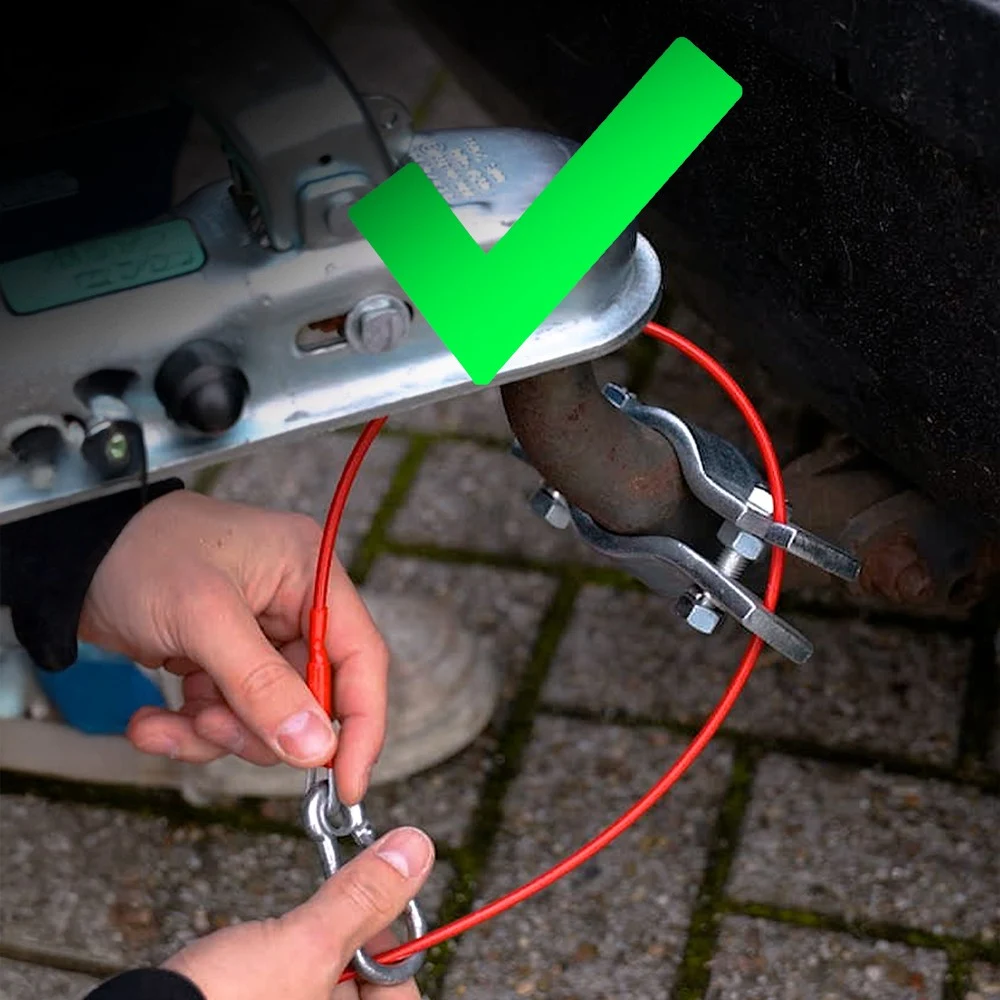
Incorrect: a loose loop around the towball neck
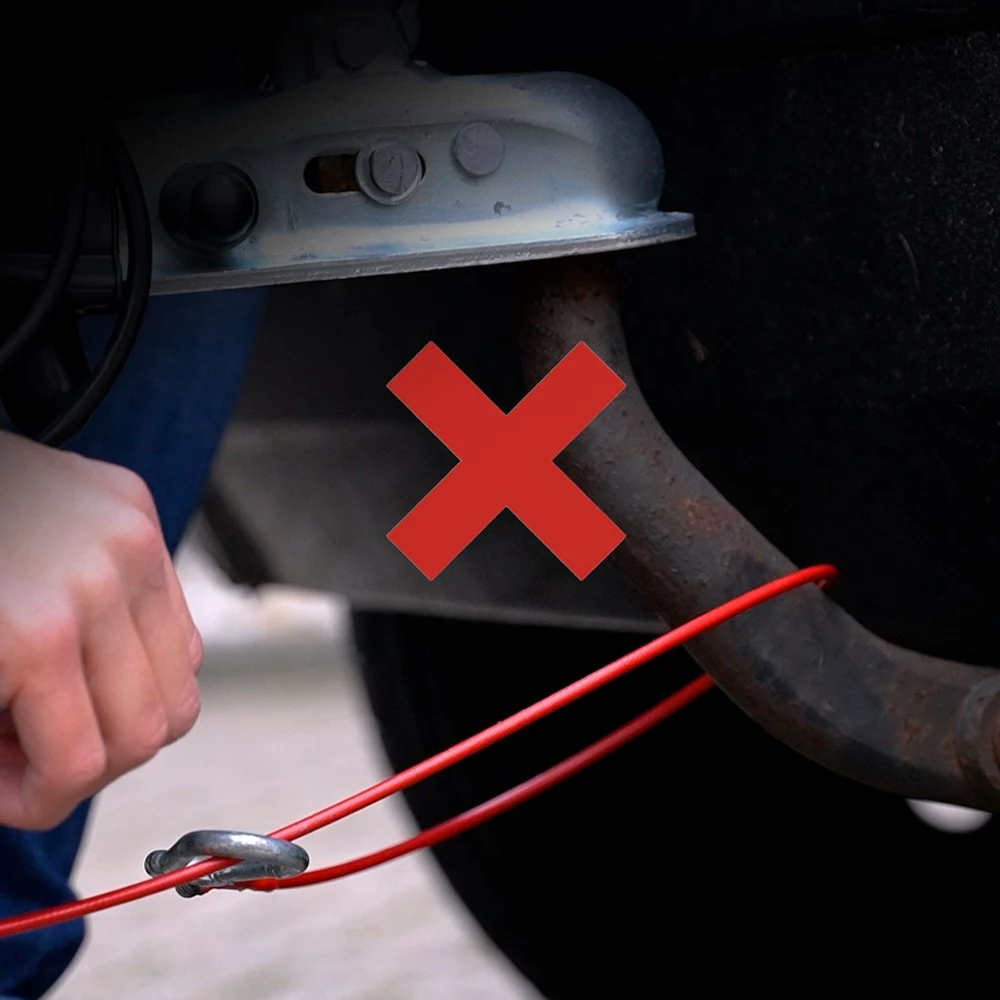
The photos show a retained and an unretained loop. Your towbar, cable and trailer instructions determine the correct attachment for your combination.
In this article
What exactly does a breakaway cable do?
A breakaway cable forms part of the emergency operation of the trailer brakes. If a braked trailer fitted with this device becomes detached from the car, the cable tightens and operates the handbrake or the associated emergency brake mechanism. The intended breakaway connection can then give way. The trailer should brake independently.
The cable is therefore not a towing cable that keeps a detached trailer behind the car. It cannot compensate for worn or incorrectly adjusted brakes either. A new cable and a suitable attachment only help if the rest of the braking system works. A breakaway cable never replaces checking that the coupling is properly locked onto the towball.
Source: HAPERT: checks before departure
A breakaway cable and a secondary coupling are different systems
These terms are often confused, but their functions differ. A breakaway cable applies the trailer brake if the trailer becomes detached. A secondary coupling, called a “hulpkoppeling” in Dutch, is an additional connection intended to keep the trailer connected to the car if the main coupling releases. It can be a cable or chain designed for that purpose.
An attachment bracket on the towbar is not the same as this secondary connection. The bracket may provide an attachment point for a breakaway cable. Do not fit an extra safety chain alongside a breakaway braking device yourself: under Dutch requirements, a trailer with a breakaway braking device must not also have a secondary coupling. If in doubt, have the correct system for your trailer identified.
Choose the correct attachment point first
Check the car or towbar instructions to find the eye designated for the breakaway cable. Its shape and location vary between towbars. Seeing a hole or bracket is not enough: the component must be suitable for this purpose. Do not attach the cable to the electrical socket, a plastic bumper part, a luggage rack or the trailer jockey wheel.
If a fixed towbar has no suitable eye, a manufacturer-approved attachment bracket may offer a solution. The combination of towbar, bracket, cable and hook remains decisive. Do not drill your own holes in the towbar or add arbitrary bolts or rings. Have a missing or unclear attachment point assessed before setting off.
Spring hook or carabiner: can you clip it on directly?
A simple spring hook designed to clip back onto the cable after forming a loop is not automatically strong enough to be clipped directly into an eye. For this type of loop attachment, the cable passes through the designated eye or approved guide and the hook closes back onto the cable, as the manufacturer specifies.
Some cables have a hook that may be attached directly. Only use this method if the manufacturer permits it for your cable and attachment point. The words “carabiner” or “stainless steel”, and a sturdy appearance, do not establish suitability. Do not replace the original hook with an arbitrary one from a hardware shop. If the type is unclear, have the cable identified.
Source: AL-KO manual (Dutch pp. 13–16) · AL-KO: cable 368605, not for direct attachment
Step by step: attaching the breakaway cable
- Park the car and trailer securely. Use the parking brakes and wheel chocks where needed. Do not work on a combination that could roll away.
- Couple the trailer according to its instructions. Check the locking mechanism and any wear or coupling indicator. Fit and secure a detachable towball first, following the towbar instructions.
- Inspect the whole cable. Look for kinks, rust, loose wire strands, damaged connections and a hook that does not close properly. Also check its connection to the brake mechanism. Do not set off if there is damage.
- Following the trailer instructions, route the cable through the provided cable guide to the designated attachment point on the car or towbar. Use the specified loop method or an approved direct hook attachment. Close the hook fully.
- Check the routing and freedom of movement. The cable must not wrap around the jockey wheel or other components, rub against sharp edges or hang onto the road. Steering and manoeuvring must not cause it to apply the brake.
- Complete the departure check. Put the jockey wheel in its specified travelling position. Check the plug, lights, tyres and load. Only release the trailer parking brake when the combination is safely ready to depart.
Source: AL-KO manual (Dutch pp. 13–16)
Why a loose loop over the towball is wrong
In the photo with the red cross, the cable is simply looped around the neck of the towball. If the coupling lifts, the loop may slide up and over the ball with it. The cable may then fail to develop the tension needed to operate the breakaway brake.
The other photo shows an attachment bracket that retains the loop. The important difference is that the cable is held in place. The photo illustrates a principle; it does not approve this arrangement for every towbar. Check that this particular bracket and method are permitted for your fixed towbar. Do not use the photo as a general fitting instruction for a detachable towball.
How much slack should the cable have?
There is no single measurement in centimetres that suits every combination. The distance to the attachment eye, the cable routing and movement between the car and trailer determine the space needed. The cable must allow normal movement while still being able to operate the emergency brake if the trailer actually becomes detached.
Too little slack can apply the handbrake unintentionally during a turn or manoeuvre. Too much loose cable can wear against the road or catch on something. Do not shorten it with knots or by winding it several times around the drawbar or jockey wheel. Have a cable of unsuitable length replaced with the correct specified cable.
Take extra care with a detachable towbar
With a detachable towball, the trailer coupling is not the only connection that can release. The detachable towball itself must also be properly locked in place. A cable fitted only around that part could become detached from the car together with the coupling and towball. The emergency brake may then not be operated.
Use the attachment point designated by the car or towbar manufacturer, preferably on a fixed part that remains attached to the car. Follow the instructions for a swivelling towbar too. Do not assume that a bracket on a detachable towball will always be sufficient. If there is no clearly designated attachment point, have the proposed arrangement checked.
What can happen if the cable is attached incorrectly?
A trailer that becomes detached and does not brake independently can keep rolling, change direction and collide with traffic, a cyclist or a pedestrian. Its load may also shift or fall onto the road. Property damage and serious injuries are possible consequences. A working breakaway brake reduces a risk, but does not guarantee a predictable path or a safe outcome.
A cable fitted too tightly can cause a different problem: the brake is applied while the trailer is still coupled to the car. This can cause jerking, additional brake wear and overheating. A dragging or trapped cable can become damaged and fail when it is needed. Incorrect attachment is also checked during roadside inspections; a fine or a requirement to remedy the fault may follow.
Damaged or activated? Have it checked before travelling
Do not drive with frayed steel strands, a broken cable, a bent hook or a defective attachment. Tape, a knot or an extra piece of cable fitted at home does not make the component suitable again. Choose a replacement that matches the overrun brake and trailer. Length, connection and hook type matter.
If the emergency brake has actually been activated through the breakaway cable, fitting a new cable alone is not enough to establish that it is safe to continue. Have the brake mechanism, handbrake, coupling and attachment points checked for loading and damage too. Do not pull the cable apart by force as a home test. Have its operation assessed in a controlled way by a specialist.
Source: HAPERT: brake maintenance
Checklist before every journey
- The coupling is locked onto the towball according to its instructions, and a detachable towbar is secured.
- The correct cable and hook are fitted and undamaged.
- The cable is attached to the designated point and the hook is fully closed.
- The cable guide is used as specified by the trailer manufacturer.
- There is room for normal turns without the cable applying the brake.
- The cable does not drag and cannot wrap around the jockey wheel or run against sharp edges.
- The jockey wheel, plug, lights, tyres and load have been checked; the trailer handbrake is released for departure.
Repeat this check after every uncoupling. A photo showing the correct attachment for your own combination can help establish a consistent routine. Use it only for that combination and continue checking the condition of the components.
Which Dutch rules are relevant?
Dutch vehicle requirements distinguish between the main coupling, a breakaway braking device and a secondary coupling. A fitted breakaway braking device must work properly. For centre-axle trailers up to and including 1,500 kg, the RDW describes exceptions to the general requirement for automatic braking when the connection is broken. The simple claim that “a breakaway cable is only required above 750 kg” therefore does not cover every situation.
Under Article 5.12.66, a trailer up to and including 1,500 kg without a breakaway braking device must have a secondary coupling. A trailer with a breakaway braking device must not also have a secondary coupling. The maximum authorised mass and specification determine what applies, not just today's load. Travelling abroad? Check the official requirements of the countries you will drive through, as well as your manufacturers' fitting instructions.
Source: RDW: breakaway brake operation · RDW: coupling and secondary coupling
Breakaway cable questions
What do the Dutch names for a breakaway cable mean?
For a typical braked trailer, the Dutch terms “breekkabel”, “losbreekkabel” and “handrembreekkabel” usually mean the cable that activates the emergency operation of the brakes if the trailer becomes detached. A “hulpkoppeling”, or secondary coupling, has a different function. Look at the operation and the instructions; the name on the packaging is not enough on its own.
Does a 750 kg trailer need a breakaway cable?
A typical unbraked 750 kg trailer has no brake mechanism for a breakaway cable to operate. It needs a suitable secondary coupling instead. If a lightweight trailer does have an approved breakaway braking device, the requirements for that system apply. Do not add a breakaway cable or safety chain yourself without establishing which arrangement is correct.
Can I clip the hook directly into an eye?
Only if the manufacturer permits direct attachment for your cable, hook and attachment point. A spring hook intended to close back onto the cable after forming a loop must not simply be used as a direct load-bearing connection.
Can the cable be attached to the jockey wheel or electrical socket?
No. The jockey wheel is attached to the trailer, so it does not provide an independent connection to the car. An electrical socket or its mounting plate is not automatically a suitable anchor point either. Use only the attachment point designated for this purpose.
Can I drive to the workshop with a damaged breakaway cable?
Do not set off with an unsafe cable or attachment. Contact the workshop first to agree on a safe solution. Tying a damaged cable together or substituting an arbitrary chain is not a solution.
Does this also apply to a caravan or horse trailer?
Yes, if the caravan or horse trailer has a comparable overrun brake with a mechanical breakaway braking device. The exact cable routing and attachment still depend on the model. Other braking systems, such as electrical emergency braking systems, require their own instructions.
How much is the fine for an incorrectly attached breakaway cable?
Incorrect attachment can lead to enforcement action. The specific offence and current tariff determine the amount. We therefore do not publish a fixed fine that could soon become outdated. A warning at one roadside inspection does not mean that the same fault is permitted at a later inspection.
How often should I inspect the breakaway cable?
Inspect the cable and its attachment before every journey. Also have the complete braking system serviced according to the trailer and brake manufacturers' instructions. HAPERT recommends brake servicing at least annually; intensive use or symptoms may require earlier attention.
Source: HAPERT: brake maintenance
Have your breakaway cable and towbar checked in Oldenzaal
Unsure which eye to use or whether your hook may be attached directly? Bring both the car and trailer. The attachment can then be assessed as a complete combination. A loose cable alone does not show everything about the towbar and the freedom of movement needed.
At Bruggink Mobility Centre, Marconistraat 35 in Oldenzaal, you can get advice, servicing and repairs for trailers. We inspect the breakaway cable, coupling and braking system and discuss any work needed. We help customers from Oldenzaal and the wider Twente region. Call or send a clear photo first if you are unsure before driving with the trailer.
Sources and checks
Sources checked on 24 November 2026. This guide covers mechanical breakaway braking systems used in the Netherlands. It does not replace your manufacturers’ fitting instructions.
Advice about your trailer?
We’re happy to help. Visit us in Oldenzaal or send us your question.